
More Than Just Food:
A Shared Agenda for Student Food Security and Success
Section I: Prevalence of Food Insecurity


Student Hunger Remains Widespread

Food insecurity continues to affect a substantial share of college students nationwide. Both the Hope and Trellis surveys revealed that food insecurity is common and is not limited to any particular institution type or student group.

More than 40% of two-year students reported being food insecure (low or very low food security) in the 30 days prior to taking the survey.


More than 30% of four-year students reported being food insecure (low or very low food security) in the 30 days prior to taking the survey.
Food insecurity is common across student populations, but rates are even higher among groups that are historically underserved in higher education (Black students, Hispanic or Latine students, parenting students, LGBTQIA+ students).
Black students were more likely to experience food insecurity than their White peers.
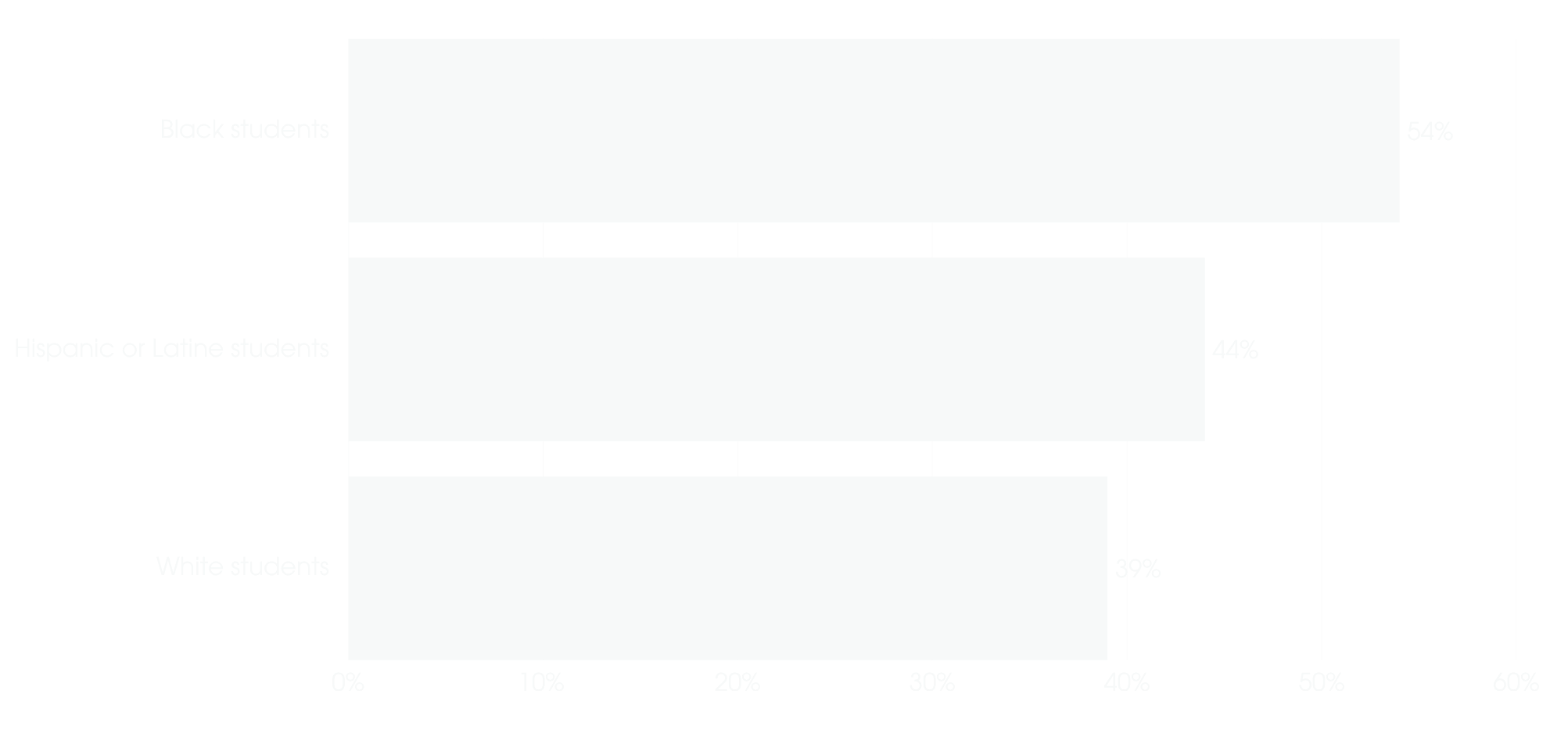
Note: The bar graph above displays data from Trellis' Student Financial Wellness Survey. The graphics below display data from The Hope Center's Student Basic Needs Survey. Patterns of results are consistent across the two surveys.Almost half of students (44%) in Hope’s sample reported that they could not afford to eat balanced meals, and 30% reported that they had cut the size of their meals or skipped meals. Among parenting students, food insecurity challenges affect their children as well: 1 in 4 parenting students (23%) reported that they could not afford to give their children balanced meals, and 1 in 12 (8%) reported that they had to cut the size of their children’s meals or have their children skip meals.

34% of non-parenting students experienced food insecurity.

53% of parenting students experienced food insecurity.

43% of LGBTQIA+ students experienced food insecurity.

34% of non-LGBTQ+ students experienced food insecurity.
53% of parenting students experienced food insecurity.
43% of LGBTQIA+ students experienced food insecurity.

Hunger Rarely Happens Alone
Food insecurity is often one symptom of broader instability.
Students experiencing food insecurity often face multiple, interconnected challenges that can compound one another and increase the risk of academic disruption. Data from both Trellis and Hope show that students who experienced food insecurity are more likely to experience other forms of basic needs insecurity, including housing insecurity, homelessness, and mental health challenges compared to their food secure peers.
Food insecure students in the Hope survey also had higher rates of technology access challenges and transportation challenges, and Trellis data demonstrate a correlation between food insecurity and missing classes due to lack of transportation or conflicts with their jobs.
Compared to their food secure peers, both Hope and Trellis data show that food-insecure students are more likely to also experience challenges accessing other basic needs. According to data from the Trellis Student Financial Wellness Survey:

19% of food secure students experienced housing insecurity.

58% of food insecure students experienced housing insecurity.

21% of food secure students experienced depression.

13% of food secure students missed at least one day of classes due to lack of reliable transportation.

29% of food insecure students missed at least one day of classes due to lack of reliable transportation.
58% of food insecure students experienced housing insecurity.

42% of food insecure students experienced symptoms of depression.
21% of food secure students experienced depression.
29% of food insecure students missed at least one day of classes due to lack of reliable transportation.

This section is part of the brief, “More Than Just Food: A Shared Agenda for Food Security and Student Success.”

Viewing on desktop, laptop, or another PC device? You can view the entire brief in one browser window!
-
Homepage: Introduction & Executive Summary
Section I: Prevalence of Food Insecurity
Section II: The Support Gap
Section III: Institutional Responses and Recommendations
For PC/Mac Users Only: Full Brief in Single-Page View
-
Student data presented in this report come from The Hope Center's Student Basic Needs Survey (47,416 student responses from 74 colleges and universities in 14 states between Fall 2024 and Spring 2026) and Trellis' Student Financial Wellness Survey (65,816 student responses 153 colleges and universities in 22 states between October 20 and November 11, 2025. Campus leader data presented in this report come from Swipe Out Hunger's Campus Leader Survey (completed by 299 campuses in Spring 2026). Methodological details and results tables are available in the Appendix.
-
Basic Needs: A persistent lack of access to essential resources necessary for maintaining health, wellbeing, and academic success, including adequate housing, food, health care and mental health services, child care, internet connectivity, and transportation.
Food security: The economic and social condition of adequate access to food
Food insecurity: The economic and social condition of limited or uncertain access to adequate food, characterized by reduced quality, variety, or desirability of diet or disrupted food intake. (USDA)
Student retention: The ability of educational institutions to keep students enrolled from semester to semester and ultimately through graduation. (EBSCO)