
More Than Just Food:
A Shared Agenda for Student Food Security and Success
Section III: Institutional Responses & Recommendations


Campuses Are Responding—But Capacity Is Under Strain
The number of campuses with food security programs continues to grow. As of the summer of 2026, over 1,000 campuses—accounting for roughly one in four degree-granting institutions across the United States—have partnered with Swipe Out Hunger to address food insecurity.


Food insecurity looks different on every campus, as do the resources, infrastructure, and capacity to address it. Common forms of food support include:

On-campus food pantries that provide free resources to students. While many of these pantries focus only on food, a number of them also provide hygiene products, baby care products, clothing, cookware, and other necessities.

Enrollment support for supplemental food programs like SNAP or CalFresh.


Meal swipe distribution programs, which allow students to donate unused campus dining credits to students who have run out of meal swipes or do not have a meal plan.

Small gift cards to local grocery stores or restaurants for students in immediate need of food.

Pre-prepared food bags for academic breaks to provide students with groceries, including holiday meal kits, while other campus resources are unavailable.
The immense impact of these programs is often in spite of limited and inconsistent resources.
$1,500
Median Estimated Program Budget
$11,000
Median Actual Program Cost

Over 40% of schools rely on donations as their primary funding source for food security resources.
“Being fortunate to continue to receive grants each year has allowed us to increase our food options and hygiene items on a regular basis. Without grants, such as the Swipe Grant, we would only be able to fund the essential food items weekly and would likely run out regularly.”
A Campus Administrator in Colorado

What Institutions Can Do Now
Institutions are making a significant difference in college food insecurity despite limited resources. With the proper financial and structural resources, college food insecurity is solvable. To achieve this, actors both within and outside of higher education need to build coordinated systems and shift away from isolated interventions.

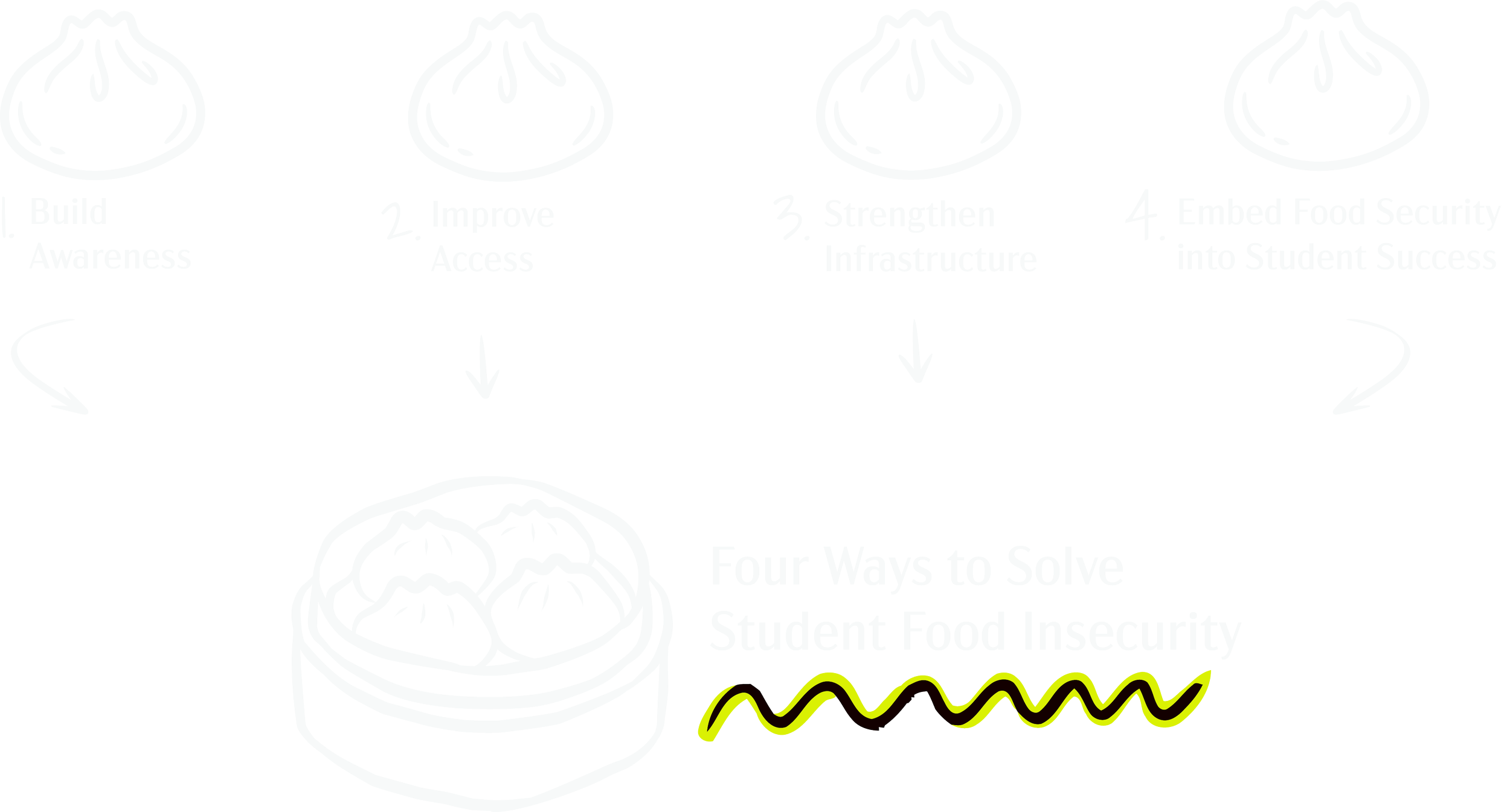
We suggest four ways to shift the needle toward this outcome:
What Institutions Can Do Now
Institutions are making a significant difference in college food insecurity despite limited resources. With the proper financial and structural resources, college food insecurity is solvable. To achieve this, actors both within and outside of higher education need to build coordinated systems and shift away from isolated interventions.
We suggest four ways to shift the needle toward this outcome:
Build Awareness
Improve Access
Strengthen Infrastructure
Embed Food Security into Student Success
Build Awareness
As discussed, many students remain unaware of the support systems that are currently available to them. Even when students are aware, stigma and a reluctance to use resources that others might need more can lead to feelings of shame about using these resources.
Students, campus staff, and their communities need to normalize conversations about basic needs and make it clear that all students have access to resources. Many students have indicated feeling more comfortable discussing basic needs insecurity with their peers, making student voices even more essential in this space. Some schools have also integrated information about their on-campus basic needs resources into orientation and campus tours. Regardless of the approach, campuses need to have strong communication strategies that not only reach their students, but properly engage and inform them about basic needs insecurity.
“One recent spring, the Art Department partnered with the campus cupboard to host a gallery exhibition inside the pantry space itself. The show was themed “Food for Thought” and featured student artwork about nourishment, resilience, and community. The art opening invited students who might not otherwise visit the pantry to come in, browse the pieces, and see the cupboard as a place of dignity and expression, not only need. A student remarked after seeing a peer’s painting, ‘I felt seen,’ and began visiting the pantry regularly.”
A campus administrator in New Mexico
Improve Access
Food support systems are only as good as the community’s ability to access them.
When planning these systems, campuses need to consider their students’ specific barriers to food access and ways to navigate them. This can include expanding or altering food pantry hours when possible; finding options for food distribution that don’t require staff or volunteers, such as food lockers or grab-and-go shelves; and empowering campus faculty to play a stronger role in food security support.
In addition to what is available on campus, institutions should consider ways to improve access for public benefits like SNAP or CalFresh. Many schools now offer SNAP enrollment support, which can be a valuable resource for the over 2 million students that are not receiving SNAP benefits despite being eligible.
“Becoming independent is such a scary thing, so having someone like the Basic Needs Coordinator help me apply for SNAP has truly changed my life and has helped me become more financially independent. I don’t have to worry about where my next meal will come from as I now have access to SNAP, something I didn’t know existed.”
A student in Oregon

St. Cloud State University

Since its founding in 2020, staff at St. Cloud State University’s Huskies Food Pantry have continued to seek new ways to better serve students. In Spring 2026, they reached a new milestone by becoming the first 4-year campus pantry in Minnesota–and just the second campus pantry overall–to be designated a SuperShelf. Created by the University of Minnesota Extension and several community partners, this designation signifies that the Huskies Food Pantry has met rigorous best practice standards for a positive student experience. These standards include service that is welcoming, respectful and destigmatizing; a grocery-store-style layout that centers student choice and dignity, and foods that prioritize nutrition and cultural inclusivity, such as kosher, halal, and gluten free items.
Bunker Hill Community College


In 2022, Massachusetts’ Bunker Hill Community College debuted their DISH & Dash Lockers, located outside the campus’s main food pantry. To use the lockers, which are refrigerated, students place an order using the pantry’s online system. Once their order has been stored in a locker, they receive a code that allows them to retrieve their food whenever it’s most convenient for them, even outside of regular pantry hours. This helps increase accessibility to the pantry’s food resources, particularly for students whose class, work, or family schedules may prevent them from otherwise using the pantry. In 2025, there were 1445 pickups from these lockers, which have since expanded to a second campus.
Bunker Hill Community College
In 2022, Massachusetts’ Bunker Hill Community College debuted their DISH & Dash Lockers, located outside the campus’s main food pantry. To use the lockers, which are refrigerated, students place an order using the pantry’s online system. Once their order has been stored in a locker, they receive a code that allows them to retrieve their food whenever it’s most convenient for them, even outside of regular pantry hours. This helps increase accessibility to the pantry’s food resources, particularly for students whose class, work, or family schedules may prevent them from otherwise using the pantry. In 2025, there were 1445 pickups from these lockers, which have since expanded to a second campus.
Institutional Examples:
Eastern Kentucky University
Eastern Kentucky University worked with its dining vendor, Aramark, to become the first university in the state to accept SNAP benefits on campus at EKU’s Provisions on Demand (POD) market. SNAP is a valuable, albeit underutilized, resource to enhance student food security that can provide greater stability over time than food provided through a traditional campus pantry. Additionally, time is at a premium for many of today’s students as they juggle coursework alongside one or more jobs and family responsibilities, such as caring for a child, siblings, or older parents. Offering a place for students to use their SNAP benefits on campus, therefore, provides a time-saving option for students to obtain food and can help mitigate challenges faced by students with limited transportation options who may find it difficult, or impossible, to access food elsewhere.
St. Cloud State University
Since its founding in 2020, staff at St. Cloud State University’s Huskies Food Pantry have continued to seek new ways to better serve students. In Spring 2026, they reached a new milestone by becoming the first 4-year campus pantry in Minnesota–and just the second campus pantry overall–to be designated a SuperShelf. Created by the University of Minnesota Extension and several community partners, this designation signifies that the Huskies Food Pantry has met rigorous best practice standards for a positive student experience. These standards include service that is welcoming, respectful and destigmatizing; a grocery-store-style layout that centers student choice and dignity, and foods that prioritize nutrition and cultural inclusivity, such as kosher, halal, and gluten free items.
Bunker Hill Community College
In 2022, Massachusetts’ Bunker Hill Community College debuted their DISH & Dash Lockers, located outside the campus’s main food pantry. To use the lockers, which are refrigerated, students place an order using the pantry’s online system. Once their order has been stored in a locker, they receive a code that allows them to retrieve their food whenever it’s most convenient for them, even outside of regular pantry hours. This helps increase accessibility to the pantry’s food resources, particularly for students whose class, work, or family schedules may prevent them from otherwise using the pantry. In 2025, there were 1445 pickups from these lockers, which have since expanded to a second campus.
Strengthen Infrastructure
Food support systems are best able to serve their communities and scale up when they are backed by strong infrastructure.
Campus systems need three main things to strengthen this infrastructure: people, funding, and tracking. Stable funding streams allow for campuses to offer more support, both in terms of how regularly they can provide resources and how much they can provide. Campus leaders need to make this a priority by providing a dedicated annual budget line for basic needs support. Additionally, annual grants are available to many institutions. Once funding is secured, campuses should consider investing in dedicated staff to decrease administrative burdens and generate more consistent capacity. In turn, capacity must be dedicated to improved data collection; when programs can track their impact, they can become more effective, which will benefit more students and build a stronger case for future fundraising efforts.
“When surveyed about how utilizing the food pantry affected their experience at [this school], 83% of students said that it made them feel less stress or anxiety about where they will get their next meal, 60% said they eat more regularly, 92% said they felt comfortable using the pantry, and 83% said ‘I feel like my college is more supportive of students like me.’”
A campus administrator in Massachusetts
Embed Food Security Into Student Success
Food security cannot be overlooked as a factor in student retention. Roughly 40% of students who exited college did so for financial reasons, and food-secure students are far more likely to graduate compared to their food-insecure peers. Therefore, integrating basic needs into retention strategies is a win-win for both institutions and their students.
Cross-campus coordination structures are a crucial way institutions can embed basic needs into student retention.
For example, some schools have expanded their fresh produce offerings through partnerships with their agricultural departments. Regardless of the specific approaches, any retention strategies should include plans to monitor outcomes and adjust interventions as needed.
“A student who was struggling to balance academic responsibilities with financial hardship after losing a part-time job and being disowned by family visited [our on-campus pantry] for assistance and was immediately met with compassion and support. Through pantry services and emergency meal programs made possible through collaborations with Greek organizations…the student was able to access nutritious groceries, hygiene products, and prepared meals throughout the semester. With their basic needs met, the student shared that they could finally focus on their studies again…”
A campus administrator in Texas

This section is part of the full brief, “More Than Just Food: A Shared Agenda for Food Security and Student Success.”

Viewing on desktop, laptop, or another PC device? You can view the entire brief in one browser window!
-
Homepage: Introduction & Executive Summary
Section I: Prevalence of Food Insecurity
Section II: The Support Gap
Section III: Institutional Responses and Recommendations
For PC/Mac Users: Full Brief in Single-Page View
-
Student data presented in this report come from The Hope Center's Student Basic Needs Survey (47,416 student responses from 74 colleges and universities in 14 states between Fall 2024 and Spring 2026) and Trellis' Student Financial Wellness Survey (65,816 student responses 153 colleges and universities in 22 states between October 20 and November 11, 2025. Campus leader data presented in this report come from Swipe Out Hunger's Campus Leader Survey (completed by 299 campuses in Spring 2026). Methodological details and results tables are available in the Appendix.
-
Basic Needs: A persistent lack of access to essential resources necessary for maintaining health, wellbeing, and academic success, including adequate housing, food, health care and mental health services, child care, internet connectivity, and transportation.
Food security: The economic and social condition of adequate access to food
Food insecurity: The economic and social condition of limited or uncertain access to adequate food, characterized by reduced quality, variety, or desirability of diet or disrupted food intake. (USDA)
Student retention: The ability of educational institutions to keep students enrolled from semester to semester and ultimately through graduation. (EBSCO)